


ALE - HF Digital Messaging - Emergency / Disaster Relief - Interoperative Communications - Ham Radio


 |
HFLINK Home |
5MHz 60 meter band
Information
News
5MHz Operating Techniques
USA Operating Guide
USA: 5MHz Emcomm
USA: Not Ragchew
USA: Not Contest/DX
USA Channel List
USA Power Level
USA 5MHz Digital Emcomm
SSB Bandwidth
IARU 5MHz WRC
UK
USA
Alaska
Finland
Iceland
Denmark
Ireland
Norway
Greenland
Australia
Germany
Bangladesh
St Lucia
Somalia
other countries
USB UpperSideband
Dial Frequency
Suppressed Carrier
SSB Bandwidth
BPL Interference
FCC Emergency Communications Declarations
Old FCC Rules
VFO Bands
Channel List
Evening Night Guidelines
Remote Base
DX caution
The Rock Band
Contact
HF Frequency Coordination
Ham Radio
Bandplans
IARU Region 2 bandplan (.pdf) 41k
IARU Region 3 bandplan (.doc) 151k
IARU Region 1 bandplan (.pdf) 55k
IARU Region 1 VHF/UHF bandplan (.pdf) 98k
Europe bandplan (.pdf) 6k
UK bandplan (.pdf) 50k
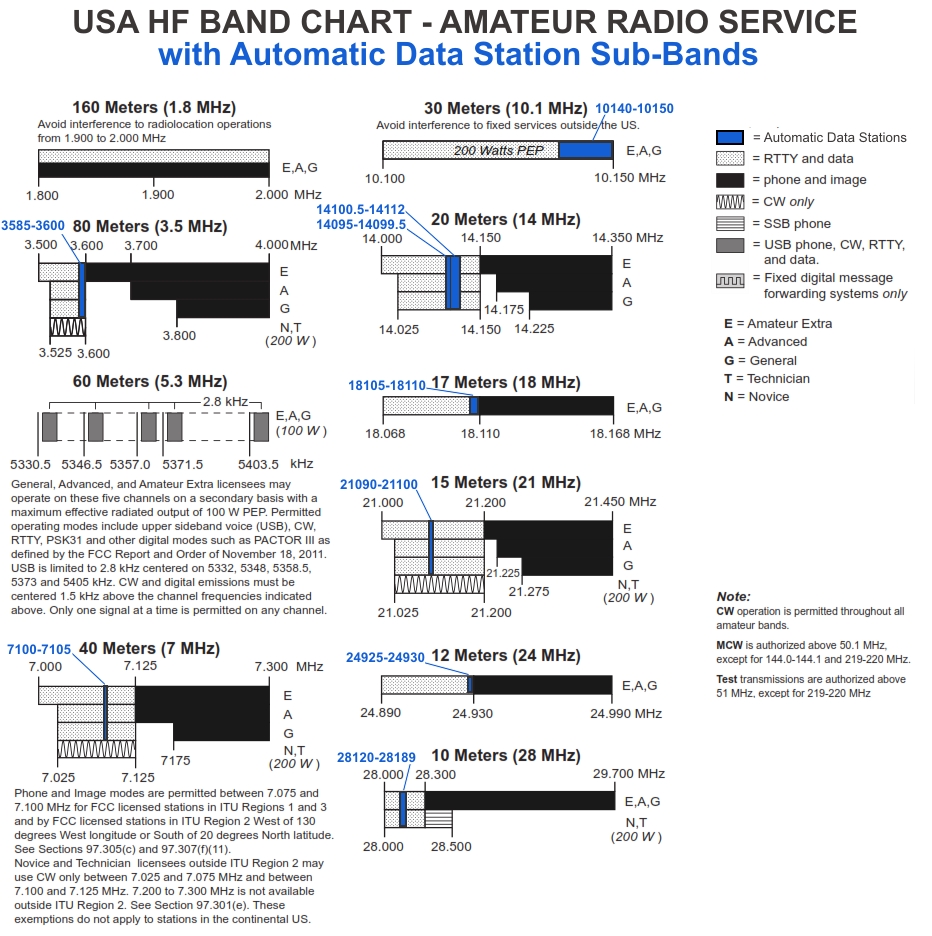
USA HF Band Chart with Automatic Sub -Bands (.jpg) 150k
ARRL old proposal USA Bandwidth-Based plan (.pdf) 131k
Australia bandplan (.pdf) 282k
New Zealand bandplan (.pdf) 45k
Japan bandplan (.pdf) 143k
Canada bands
South Africa bandplan (.pdf) 19k
Somalia bandplan Amateur Radio Info
ALE amateur radio network for HF Automatic Link Establishment, Emergency and Disaster Relief Communications
India Amateur Allocation (.pdf) 61k
10MHz frequencies (30 metre band) Digital Automatic Subband Chart (html)
18MHz frequencies (17 metre band) Digital Sub Band Activity Charts
Bandplans.com listing for various centers of activity frequencies worldwide
Norway Amateur Radio Frequency Bands
St. Lucia Amateur Radio Frequency Bands
Recommendations for Changes to IARU Region 2 Bandplan
More 5MHz Information:
wikipedia
G4MWO Worldwide Amateur 5MHz Allocations Chart
| International
5MHz Ham
Radio 60
meters Band Information 60 metres, also known as "The Rock Band" This is the first 5MHz international amateur radio website, established in 2002.
 Worldwide 5 MHz Channel List (Historical Reference)
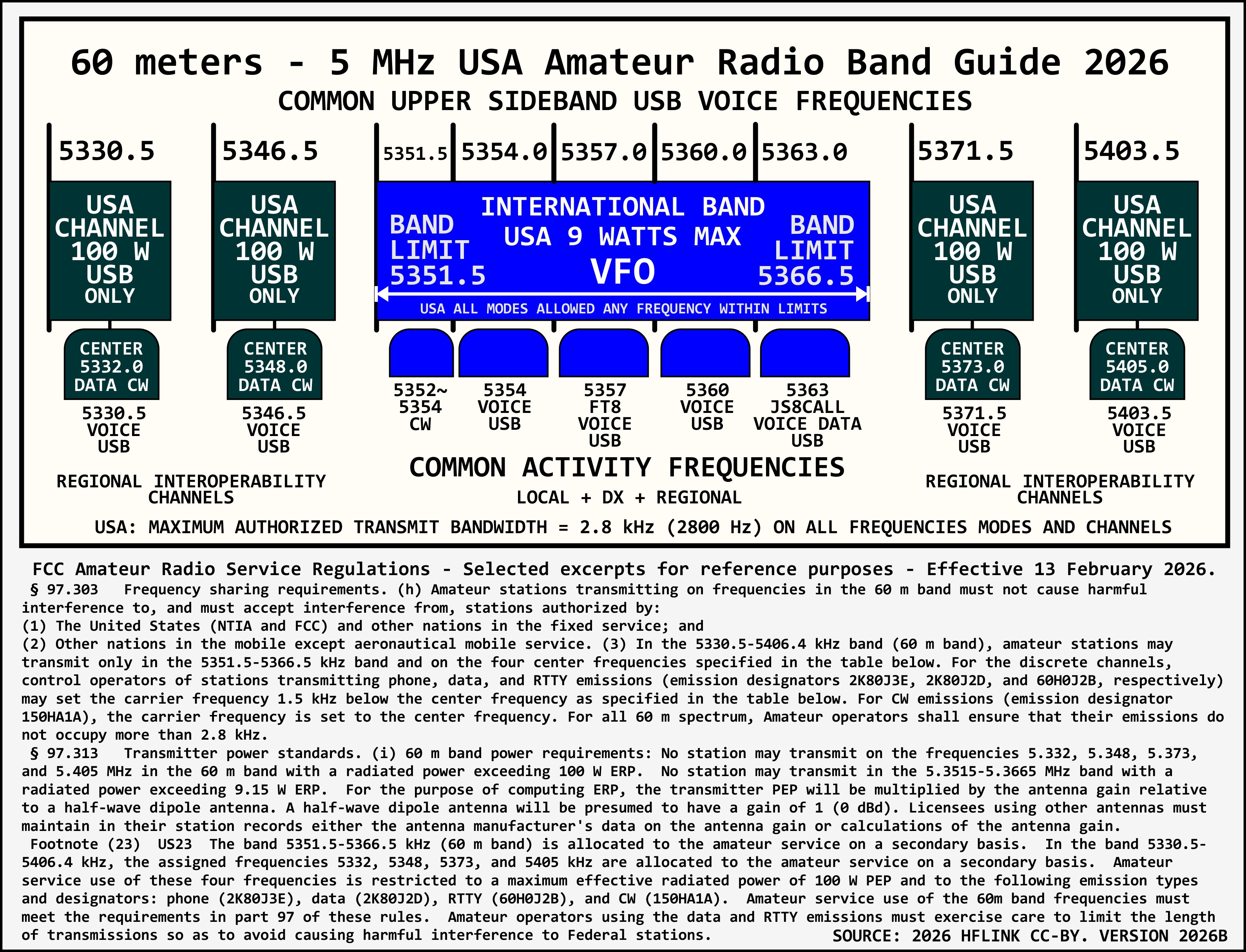
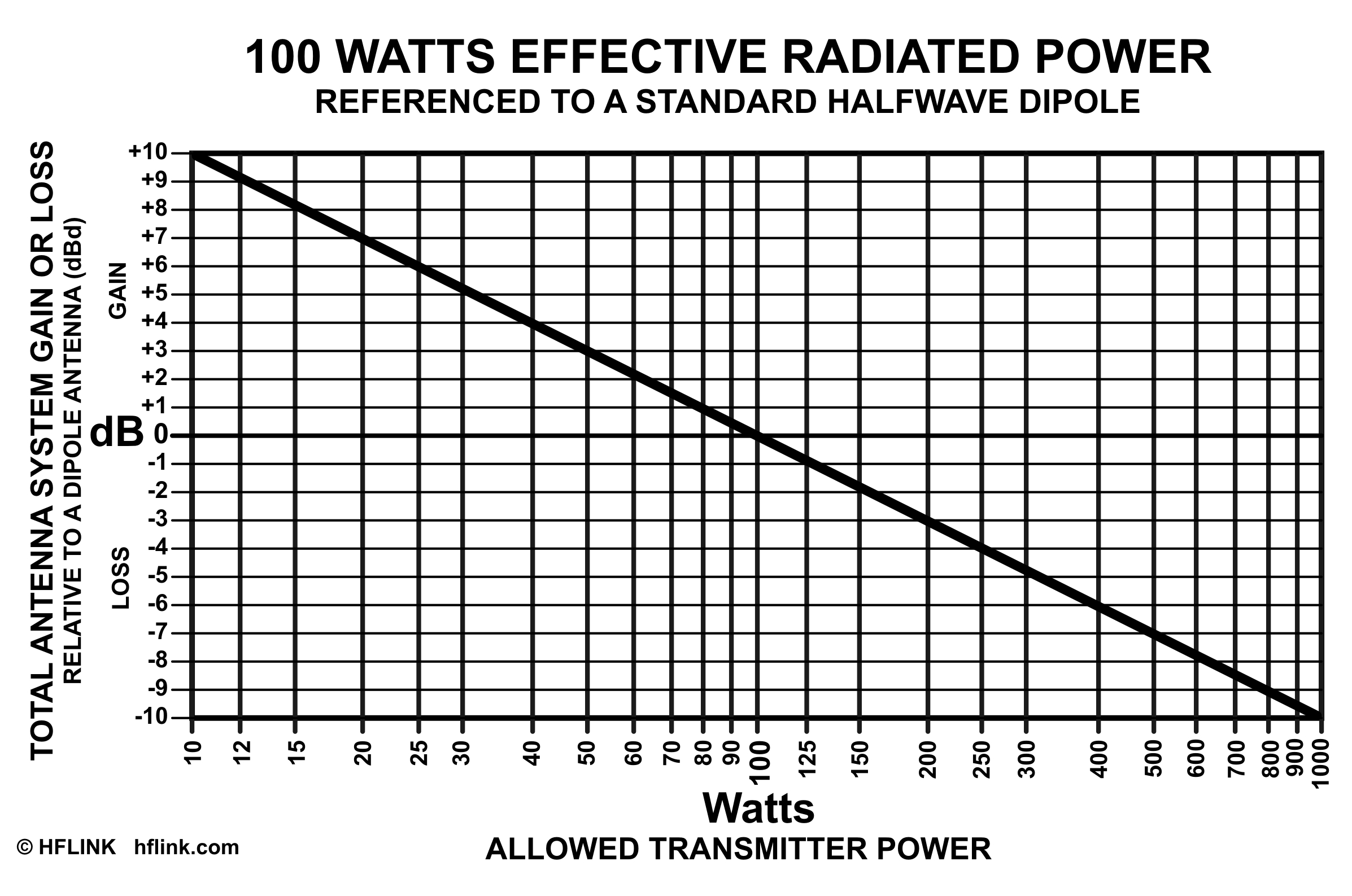
©2019~2002 HFLINK. All Rights Reserved. About 60 meters... "The Rock Band" 5MHz has predictable propagation qualities that combine the best aspects of 40 meters and 80 meters. In areas of the world above 35 degrees of latitude, 60 meters is often the best (or only) NVIS band during daylight hours. In more equatorial latitudes, 5MHz provides constant NVIS communications during hours of twilight and darkness. Many non-governmental and governmental HF systems around the world depend upon 5MHz daily. The Rock Band is always open to somewhere. In 2003, when activity first began in USA on 5MHz, Bonnie Crystal KQ6XA was on the air talking with a group of stations in California. That evening, she coined the term The Rock Band to refer to the 5MHz ham band. She said "It is as solid as a rock! ... and it is also channelized, so 60 meters seems fit to be The Rock Band." The term caught on among hams. Now, The Rock Band has become widely used for EMCOMM nets, disaster readiness, and regional QSOs. Historical Notes on the International 5MHz Frequency List 1) Dial Frequency: Above listed USB frequencies are "dial frequency" as you see them on your radio VFO. The center-of-channel offset is already figured out for you. (The center-of-channel is usually 1.5kHz higher than the dial frequency). 2) International USB Standard: The worldwide standard for Amateur Radio on 5MHz is Upper Sideband (USB). Other emission types and content are also in use, including digital, data, and morse code CW. 3) USA: New rules for 2012: All General class or higher licensees are authorized to transmit 2.8kHz maximum bandwidth, using the equivalent of 100 Watts PEP to a dipole. Hams are secondary service, and must not interfere with other services. Data modes are allowed within the channel. RTTY modes such as PSK31 keyboarding must use no greater than 60Hz necessary bandwidth. Phone, Data, and RTTY modes may use the USB (suppressed carrier) dial frequency listing in the chart. CW must transmit at the center-of-channel frequency only! 4) UK: As of January 2013, UK now has multiple splintered band segments of various frequencies. Operation requires Notice Of Variation (NOV) special permit. 100Watts PEP transmitter output power (max 200 Watts PEP EIRP). All modes. Max bandwidth 6kHz, except in the 3kHz segments where it is max 3kHz bandwidth; signal must not extend outside the band segment frequency limits. Max antenna height 20m Above Ground Level. 5) Germany: ITU Band. Historical: DRA5 Experimental Beacon, operated by DARC (DK0WCY beacon team), transmited propagation data (dial+1500Hz) CW/RTTY/PSK31. 6) Canada: Canadian Table of Frequency Allocations 2018 Edition. Footnote C21 (CAN-18) Amateur service operators may transmit in the frequency band 5351.5-5366.5 kHz and on the following four centre frequencies: 5332 kHz, 5348 kHz, 5373 kHz and 5405 kHz. Amateur stations are allowed to operate with a maximum effective radiated power of 100 W PEP in each channel and are restricted to the following emission modes and designators: telephony (2K80J3E), data (2K80J2D), RTTY (60H0J2B) and CW (150HA1A). Transmissions in any channel may not occupy a bandwidth of more than 2.8 kHz. Such use is not in accordance with international frequency allocations. Canadian amateur operations shall not cause interference to fixed and mobile operations in Canada or in other countries and, if such interference occurs, the amateur service may be required to cease operations. The amateur service in Canada may not claim protection from interference by the fixed and mobile operations of other countries. Canada 5MHz Historic note: In 2003-2007, an experimental licensed operation by Marconi Radio Club (VO1MRC) members used CW or USB on 5260, 5269, 5280, 5290, 5319, 5400 and 5405 kHz with 100 watts output, and issued reports on the results of the experiments. 7) Finland: Club stations may apply for authorization to operate the 5MHz channels with maximum power of 50 Watts on USB only. The USB dial frequencies for Finland are: 5288.6, 5298.6, 5330.6, 5346.6, 5366.6, 5371.6, 5398.6 kHz. 8) Australia: USB only. Wireless Institute Civil Emergency Network WIA. WICEN Non-amateur callsigns AXF404 or AXF405 or VXE580. ACMA type approved land mobile radio equipment (i.e. Barrett, Codan, QMAC, commercial Icom, etc) registration required. VKE580 on 5425 kHz USB - Amateur Radio New South Wales, WIA, broadcasts VK1WIA National news and local VK2WI news on Sunday morning at 10 AM local time, on this 5MHz commercial Emcomm channel. According to their website: "The transmission using the callsign VKE580 has been added to provide linking for manual relay stations. Callbacks cannot be taken on this frequency as it is currently a Commercial frequency allocation. Note that transmission is Upper Sideband (contrary to normal amateur practice below 10MHz) " 9) Remote bases and Echolink HF stations: Some HF remote base stations in USA have operated on 5371.5kHz, using Internet Remote Base or Echolink with voice squelch and/or UHF remotes. Channelized HF operation provides excellent compatibility for remote base operation. 10) Iceland: 5260 – 5410 kHz band (replaces 8 channels). Maximum power 100W ( 20 dBW ). 11) Bangladesh: 5250 to 5310 kHz Amateur Applications; Amateur propagation experiments with stations of administrations permitting such activities. Secondary status. 12) St. Lucia (J6) has the same 5 channels as USA and there continues to be activity. 13) Greenland: VFO band. SSB, CW, or Digital. 14) Other countries: Some other countries reported to have 5MHz activity, officially or unofficially: Andorra, Czech, Kenya, Greece, Columbia, Russia, Turkey, Belize, Ascension Island, Panama, Honduras, Italy, Grenada, Suriname, Guatemala, Costa Rica, Nicaragua, Morocco, Trinidad & Tobago, Barbados, Cayman Islands, Ghana, Slovak, Portugal, Switzerland, Croatia, Ireland, Luxembourg, Bermuda, Kuwait, Caymans, New Zealand, Ascension, Bulgaria, Ghana, Kirabati, Sierra Leone, Niue Island, and Mexico. 15) Norway: 5260-5410kHz full band with VFO at 100W. Operation with VFO within the passband of the recognised common international channels should tune directly to the channel frequency. 16) Denmark: 5260-5450kHz full band with VFO all modes. Maximum 1kw ERP, Bandwidth 8kHz. 17) Alaska Emergency Frequency, USA: The frequency 5167.5 kHz USB may be used by hams in Alaska in case of emergency, to communicate with hams or PART 90 PRIVATE LAND MOBILE RADIO SERVICES in Alaska. Max 150W PEP. Must be within 50 nautical miles (92.6 km) of the State of Alaska. May also be used for establishing communication before switching to another frequency. For tests and training drills necessary to ensure the establishment, operation, and maintenance of emergency communication systems. FCC table of frequency allocations Footnote US212. 18) Somalia: 5060-5450kHz full band with VFO all modes, as of 2004. Max 3kW. May be used to communicate with non-ham users of Somalia's license-free 5MHz band, and others. Licenses issued in Puntland. See more info on Somalia ham radio. 19) Dominican Republic: 7 channels SSB and CW. 20) New Zealand: Channel width: 2.8kHz. EMCOMM, Secondary use on a Non-Interference basis. Only for recognised AREC activities, using AREC callsigns. 21) Barbados: 100W PEP USB Voice VFO band. 22) Sweden: ITU Band 23) Update: Feb 2014. The number of countries allowing amateur radio operators to use frequencies in the 5MHz band increased during 2007-2014. Some countries do not widely publish their amateur frequency bands, or only provide special operating authorisation for 5MHz on an individual basis. It has now become extremely difficult to acquire and follow all the changes happening with 5MHz around the world. In the case of non-published telecom frequency allocations/authorizations, we rely upon private email information from amateur radio operators in each country. The channel and frequency assignments are evolving, and therefore, this site will also try to maintain some references for historical purposes. 24) Samoa: In mid-2013 Samoan telecomms regulator OOTR (Office Of The Regulator) authorized 5250-5450 kHz at 100 Watts without other restrictions, any mode. Prior to that, there were various individual channelized temporary licenses issued. Evening/Night Guidelines: 5MHz channels are a shared resource with many users. Especially on this band, it is very important to use the lowest power necessary for communications. The Rock Band is always open to somewhere. At night, you may find that 20 Watts is sufficient. In many countries, amateurs are secondary users and must QRT when a primary station is on the channel. For this reason, transmission time should be kept to a minimum, and it is best to wait a few seconds before responding during a QSO conversation. Considerate hams usually try to avoid longwinded ragchews during peak evening hours whenever activity is high and propagation is open for wide regional communications on the 5MHz channels. Useful operating techniques for the 5MHz channels: 1. Put the 5MHz channels in your transceiver memory, including the USB mode. If possible, also include narrow TX bandwidth (2.4kHz transmit filter) and the correct transmit power level. 2. Before transmitting, check your transceiver calibration against a time/frequency reference signal such as WWV on 5000.000 kHz. Select a channel, check your power setting, lock your VFO dial, and lock your microphone "channel Up/Down" switch and keypad. 3. Use your RIT or receive clarifier to tune other stations in. Do not change your main VFO dial or transmit frequency unless you discover that you are out of calibration. 4. Avoid long auto-tuning or manual-tuning times if possible. Transmission of a dead carrier, especially zero-beat, is not allowed in some countries (such as USA). 5. How to make a contact: Before starting to transmit, listen on the channel for at least 3 minutes. If it is vacant, start by just saying CQ and your CALLSIGN once using standard phonetics. Listen for any response. It is not necessary to call a long CQ on a standard 5MHz channel. Often, simply announcing your callsign and location can sometimes be enough to start up a contact. 6. If you have a very high receive noise level at your QTH, be very cautious about transmitting because you may be interfering with primary users or a QSO that is already in progress between amateurs. 7. Try to peacefully co-exist and share the channel with other ham signals in the background. Unlike other HF SSB ham bands, 5MHz is channelized and very limited. Don't insist upon a totally clear channel, because it is possible for there to be several layers of ham QSOs going on simultaneously in different areas on the same channel. If anyone requests immediate access to the channel, acknowledge the request, and immediately stop transmitting. 8. ID more often than you normally would. Once you establish contact, say your callsign and the callsign of station you are talking to. This will help a lot when there are multiple stations simultaneously using the same channel. 9. Avoid longwinded ragchewing. Use short transmissions, drag your feet between overs, and give everyone a chance to use the channels. 10. Be open to other stations calling each other between gaps in your QSO. 11. Channel Names: Avoid saying "Channel One, Channel Two", because there are at least 20 Channels on 5MHz around the world now, and the list is growing. Also, some radios have older or obsolete channel memories for 60 meters. Among regular 5MHz operators, the channels are often called by the last few digits in kiloHertz, such as "403.5" (meaning the dial frequency 5403.5kHz). Note: FCC Changed USA Amateur Radio 5MHz Rules in 2012 The USA FCC changed its rules for the Amateur Radio Service at 5MHz. Here is a basic overview of the changes and rules in plain language, as they apply to the Amateur Radio Service in USA.
SSB BANDWIDTH Operating with a 2.5kHz filter, an Upper Sideband transmitter set at 1.5kHz below the center-of-channel frequency, with a typical voice bandpass of 300Hz to 2800Hz, the signal will just barely meet the requirements of the FCC rules for the 2.8kHz channel. 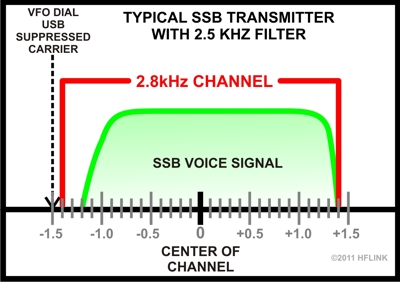 DIGITAL KEYBOARDING MODE BANDWIDTH For USA operators using a digital keyboarding mode, the maximum bandwith is 60Hz and the signal must transmitted at the Center of Channel only. If you use your VFO dial frequency, it should be set the same as if you were using Upper Sideband voice, and your PSK31 audio center should be 1500 Hz exactly. If you use a digital computer program that displays your signal center instead of your dial frequency, it should be set to the Center of Channel frequency. Operators should also monitor Upper Sideband voice to avoid interference.  CW MODE For USA operators, CW must be transmitted at the Center of Channel only. CW operators should also monitor Upper Sideband voice to avoid interference.  DATA TRAFFIC For USA operators sending DATA traffic, the maximum signal bandwidth is 2.8kHz. Operators should also monitor Upper Sideband voice to avoid interference. 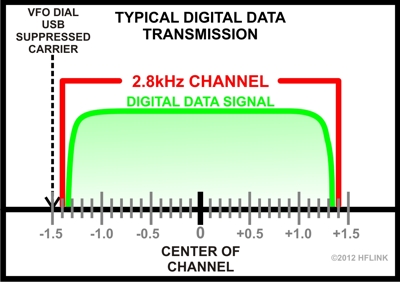 Behind the FCC rule changes: about the FCC 5MHz Rulemaking and governmental process... A report from FCC on the rule changes sent to the US Senate Committee on Commerce, Science, and Transportation was assigned Executive Communication number EC-4237 in December 2011, and a communication from the Chief of the Policy and Rules Division, Office of Engineering and Technology, Federal Communications Commission, transmitting, pursuant to law, the report of a rule entitled "Amendment of Parts 2 and 97 of the Commission's Rules to Facilitate Use by the Amateur Radio Service of the Allocation at 5 MHz" (FCC 11-171) received in the Office of the President of the Senate on December 5, 2011; to the Committee on Commerce, Science, and Transportation. The summary of report and order was published in the Federal Register on 03 February 2012. The Table of Frequency Allocations for the 5.06-5.45 MHz segment was amended:  USA Emcomm Digital Data The new FCC rules for 5MHz do not contain any 300 baud symbol rate limitation. Instead, the 5MHz channels have a bandwidth limit of 2.8kHz. The 5MHz ham channels are thus suitable and legal for various modems, such as PACTOR3, PACTOR4, and the MIL-STD 188-110 PSK-2400 waveforms, and others that have 2.8kHz bandwidth or less. Automatically Controlled Data Stations are not allowed, however. So, any use of 5MHz must be with an operator active on both sides of the QSO. Still, this provides a wonderful opportunity for fast email or data traffic regional comms in Emcomm scenarios. The same QSO can be a mix of voice SSB and data; this is a feature not available on other HF bands. 5MHz was established to serve Emcomm. It is important that all ham operators involved with HF Emcomm increase their capability for the 5MHz 60 meter band for base, mobile, and portable operation. These channels are also open for the possibility of Interoperation during emergencies with other disaster response agencies and organizations. STATUS UPDATE= FAILED IARU Proposes International 5MHz Ham Band Secondary Status 150kHz Wide The IARU Administrative Council met in Sun City, South Africa on 19 August 2011, and announced their strategies for upcoming World Radiocommunication Conference (WRC) agenda. They established 4 major spectrum allocation priorities:
Although the IARU Administrative Council did not detail the exact band edges proposed, there have been other references in international conferences to the possible band limits: 5260 kHz to 5410 kHz. These are the same band edge VFO frequencies already in effect in some countries. The ITU Table of Frequency Allocations indicates that the primary use of the band is allocated to "5250 kHz to 5450 kHz, FIXED, MOBILE except aeronautical mobile". For more information, please see the complete IARU Administrative Council 2011 Summary Record. FAILED: World Radiocommunication Conference Information from WRC12 in February 2012 indicates that a proposal for an international Amateur Radio allocation with secondary status around 5.3 MHz (5250~5450 kHz contiuous or non-continguous) is likely to be on the agenda for the next WRC15 in 2015. There has been opposition from many countries and regional spectrum organizations. USA has said it would support 15kHz around 5.3 MHz... approximately the same as USA's present channels! Some other countries already have already assigned portions of this spectrum to hams on a secondary or Emcomm basis. We are likely to see more countries supporting it through compromises, and this could result in a 60 meter global ham band (or regional sub bands) after 2015. Other WRC12 News: Oceanic radar systems are being allocated 5250-5275kHz. This overlaps some of the area of existing 60 meter band amateur and Emcomm. USA FCC "Emergency Communications Declaration" information for USA emergency net operators using 5MHz: In 2004, the FCC changed its general policy for issuing Emergency Communications Declarations (ECD) on Amateur Radio Service frequencies. ECDs typically are issued to temporarily protect certain frequencies for emergency net use only. The policy says that ECDs may now be issued for one or two 5MHz channels and/or VHF/UHF frequencies. Prior to this policy, ECDs typically were issued during weather-related and wildfire emergencies for frequencies in the 75 and 40 meter bands. The FCC also said that frequencies in other Amateur Service bands where emergency nets already have been established may be used during emergencies under the provisions of rule §97.101c (which stipulates that Amateur Radio Service operators give priority to stations providing emergency communications at all times and on all frequencies). ©2012, 2011, 2010, 2000, 2001, 2002, 2003, 2004, 2005, 2006, 2007,2008,2009 HFLINK. All Rights Reserved.
USA: 5MHz for EMCOMM, not Ragchew, not Contest/DX --an article by
Bonnie Crystal KQ6XA
The 60 meter ham band has quite different operating privileges in various countries of the world. The frequencies, rules, purpose, regulations, operating procedures, and levels of priority are all different in each country. In USA, the 5MHz channels for ham radio were specifically requested, justified, and approved primarily for Emergency and Disaster Communications. The stated justification is the need for NVIS and regional disaster response communications to fill in the propagation gap between 40 meters and 80 meters. The process of the Amateur Radio Service gaining access to these 5MHz frequencies was long and exacting. Recently, due to another multi-year process of proposal and rulemaking, FCC increased the privileges slightly for hams on 5MHz. However, the FCC put even tighter technical restrictions on 5MHz operation than on any other ham bands. 60 meters is not a normal ham band. In this new ruling, FCC re-affirmed and clearly spelled out major restrictions for hams on 5MHz. Hams are secondary users (or less) and the Primary users of the 5MHz channels must not be interfered with in any way that harms their communications. Non-interference with a Primary user isn't just a matter of stopping transmitting if you are asked to. It can also mean refraining from transmitting, if there is any chance that you might be preventing a Primary user from utilizing or starting communications on the channel, even if you are not asked specifically. The only way we can hope to fulfill our requirement for non-interference, is to use very short transmissions and listen/watch carefully between transmissions. What are some common amateur radio operating practices that may not be suitable for 5MHz 60 meter band operation in USA? 1. Calling CQ DX repetitively. 2. Long CQs. 3. Longwinded ragchews. 4. Calling in pile-ups. 5. High power transmissions. 6. Contesting. 7. Sending a long brag file on PSK31. 8. Transmitting without listening first. 9. Split DX exchanges. In order to be ready for Emergency/Disaster Communications, hams need to have good familiarity with the band and have equipment capable of operating 5MHz. Hams can only do this by participating in active operating on the 5MHz band. Somehow, we need to achieve a balance between a good level of activity and the requirement for non-interference. Finding this balance may be difficult, but for the most part, hams are quite adept at good operating habits. Every ham operator transmitting on 5MHz must pay special attention to the different operating methods and procedures that this unique authorization requires. There are proposals in the works to create an international ITU allocation of a 60 meter Amateur Radio Service band with Secondary status. If hams in USA are found to be operating in ways that disregard the spirit of the requested, justified, and approved reasons for which we obtained 5MHz privileges, then it may be extremely difficult to ever get FCC support for increased spectrum. Regards, Bonnie Crystal KQ6XA ©2012 HFLINK. All Rights Reserved. ARRL Expresses Concern Over 5MHz DXing DXING ON 60 METERS HAS DOWNSIDE, ARRL NOTES. 5MHz interference from BPL and HomePlug transmitters: Some Broadband Over Power Line (BPL) and in-building powerline communications systems (PLCs) use HF and low VHF spectrum for transmitting signals which radiate in the general area of the power lines. Some of these systems have voluntarily conformed to the HomePlug standard which uses "spectrum notches" in most of the HF ham bands in their effort to mitigate some of the interference they cause to hams. However, the existing HomePlug standard does not provide spectrum notches for the 5MHz channels. The USA FCC requires that any new BPL systems have the capability to notch out frequencies whenever they generate interference to licensed services. However, in practice, it is has been difficult to get BPL systems to deal with interference complaints. For reference purposes, here is a list of the USA FCC-authorized BPL (Broadband over Power Lines) transmitting bands for USA 1.705 MHz to 2.850 MHz (160m Amateur Radio Service) 3.025 MHz to 3.400 kHz 3.500 MHz to 4.650 MHz (80m Amateur Radio Service) 4.700 MHz to 5.450 MHz (60m Amateur Radio Service) 5.680 MHz to 6.525 MHz 6.685 MHz to 8.815 MHz (40m Amateur Radio Service) 8.965 MHz to 10.005 MHz 10.100 MHz to 11.275 MHz (30m Amateur Radio Service) 11.400 MHz to 13.260 MHz 13.360 MHz to 17.900 MHz (20m Amateur Radio Service) 17.970 MHz to 21.924 MHz (17m,15m Amateur Radio Service) 22.000 MHz to 74.800 MHz (12m,10m,6m Amateur Radio Service) 75.200 to 80.000 MHz Note: The above information about BPL is only provided as a reference guide for those who are using 5MHz and experience interference from BPL.
|
||||||||||||||||||||||||||||||||||||||||||||||||||||||||||||||||||||||||||||||||||||||||||||||||||||||||||||||||||||||||||||||||||||||||||||||||||||||||||||||||||||||||||||||||||||||||||||||||||||||||||||||||||||||||||||||||||||||||||||||||||||||||||||||||||||||||||||||||||||||||||||||||||||||||||||||||||||||||||||||||||||||||||||||||||||||||||||||||||||

END OF PAGE
©2019~2001 HFLINK. All Rights Reserved.
HFLINK, HF-LINK, HF LINK, and the HFLINK Logo are trademarks of HFpack Inc. Any external hyperlinks must only be to the main page of the HFLINK.COM website http://hflink.com . Capture of the HFLINK website or any part of it within the frame of another website is not permitted. HFLINK group forum is a private group. Public archiving, forwarding, or open display on the internet of HFLINK group forum or messages is forbidden. All text and images on the HFLINK website are property or copyright HFpack Inc, or when used by permission, are copyright by their respective owners, with all rights reserved.
HFN and High Frequency Network are service marks and trademarks of HFpack, Inc. No part of the HFLINK website or HFLINK Group Forum may be used or copied without written permission of HFpack Inc.