

Selcall - Digital Selective Calling - HF Digital Messaging - Emergency / Disaster Relief - Interoperative Communications - Ham Radio


HF
Selcall (Australian type 4-digit and 6-digit type)
 |
HFLINK Home |
- Amateur
Radio HF Selcall Channel Frequency List
- Selcall
CCIR 493-4 Australian Type 4 digit Address Format
Diagram
- CCIR 493 Table of Character Bit Coding
- Reference Documents ITU-R and CCIR Selcall Evolution
- Selcall
Signal Modulation Frequencies Coding Speed Protocol
Frequency Accuracy
- Ham Radio Selcall Address Database
- Selcall System Process Description
- Types of Selcalls Commonly Used
- Sample Selcall Audio File
- Protocol Details
- Service
Command Characters
| HF Selcall This is an informational resource for HF Selcall. Selcall CCIR 493-4 is the primary focus of this resource, and the variations of it that have been developed for modern HF selective calling as used in HF SSB Land Mobile applications. It functions as incidental tones for selective calling and alerting for voice communications. References for ITU-R M.493-n (Marine GMDSS DSC) types of digital selective calling also are included. The long term objective of this resource is to provide information about the use of these types of HF Selcall in various radio communication services. Please refer to the original documents of the various standards and recommendations for more detail and updates. Background HF Selcall using FSK 100 baud has been in use for many years in land mobile service in the Australia region and remote areas of the world. It is common among international disaster relief and aid organizations' HF vehicle and base communications. This selcall system is mainly based on CCIR Recommendation 493 (XIIIth Plenary Assembly Geneva 1974) for a Digital Selective-Calling System for use in the International (Terrestrial) Maritime Mobile Service. It has gone through many revisions such as 1978 Kyoto CCIR 493-1 and later CCIR 493-4, which provide the coding of the FSK signal and the structure of the format for signalling. The protocols and format of this system were enhanced to provide various features and services, including: selective calling, telephone number calling (phone patch call), group call, all call, and remote control. It has been expanded over the years to include: location reporting (GPS), emergency call, text messaging (HF paging), and SMS-texting, text email, and more. Ham Radio Use of Selcall The availability of Aussie selcall in various types of commercial HF radios, especially Codan, has led to ham operators using it for ham radio selective calling applications, primarily for voice SSB and data communications. The Amateur Radio HF Selcall Channels are available for all ham operators to use. A database of Ham Radio Selcall Address is maintained by HFLINK group. |
4-digit and 6-digit
Selcall Address A selcall address is like a phone number. The earliest systems of this type of Selcall used unique identification addresses of 4 digits in length. The 4-digit type is the most common Selcall system in service throughout the world for land mobile HF service. But, due to the limitations of the number of possible unique addresses (9,999) in the 4-digit system, the protocol for land-based HF was expanded to 6 digits, capable of 999,999 unique addresses. Much of the earlier CCIR 493 format, coding, and signalling standards have been retained in the modern marine DSC. The maritime system selcall ITU-R 493.9+ has expanded the addressing and features in what is known as marine Global Marine Distress Safety System Digital Selective Calling or (GMDSS DSC) for use in ships and boats on HF and VHF throughout the world. However, most HF land-based services have remained with the 4-digit and 6-digit system. In most implementations by HF SSB Land Mobile equipment manufacturers (Codan, Barrett, QMAC, Micom, Icom, Vertex, Jenal, etc) the 6-digit is backward compatible with 4-digit. In other words, a 6-digit selcall radio can also call a 4-digit address, but not vice-versa. Most 4-digit radios cannot decode a 6-digit selcall. Example of a 4-digit selcall address: 1234 Example of a 6-digit selcall address: 456789 |
| Modulation:
2aryFSK (FSK), with 170 Hz shift. The
frequency shift point of waveform inter-symbol
transition is not specified in the protocol; in practice
it does not affect the performance very much, so the
transition can be at the negative or positive peak or
zero-crossing of the signal, or in between. Only a
single tone is present at any time interval (like
traditional RTTY FSK). Fixed baseband
audio frequency of the FSK encoder and decoder is used
with an SSB transceiver on HF channels. Upper Sideband
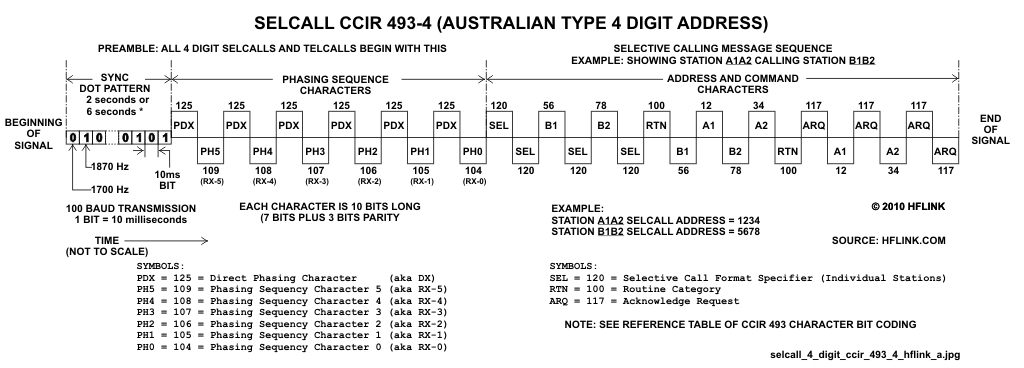
(USB) is most common. Baseband FSK Frequencies: The Australian standard (Codan or U.N. Open Source Selcall) is the most common for HF SSB Land Mobile. CCIR 493-4 HF Land Mobile International Standard shift FSK is 1700Hz=0 and 1870Hz=1 (Center frequency= 1785Hz). [Note: Marine GMDSS DSC CCIR 493-9+ for HF SSB is 1615Hz=0 and 1785Hz=1 (Center frequency=1700Hz)] Symbol: The shift symbol is represented in both the CCIR and ITU-R tables of bit coding as B=0 and Y=1 (1700Hz is the B-state and 1870Hz is the Y-state of the signal elements). [Note: Marine GMDSS DSC: 1615Hz is the B-state and 1785Hz is the Y-state] Code: 10-bit words allowing error detection, with a 128 characters set. The character symbols 0 though 99 are used to transmit numerical values, and the number of the character symbol is equivalent to the value.The meaning of service command character symbols 100 to 127 depends on their position in the message and on the message format. Speed:100 baud (100 symbols/sec or 100 bits per second at RF) for HF signalling. Each bit is 10ms (10 milliseconds) in length. Raw 10 Characters/second. Protocol: A "dot pattern" of 0101010101... frequency shift keying for at least 2 seconds (or 6 seconds or 20 seconds) starts the signal. The purpose of the pattern is two-fold: 1. To capture all channel-scanning receivers on the transmitted signal. 2. To provide sync lock for the decoding. After the initial dot pattern, a phasing sequence is sent consisting of a set of known service command characters, in a "countdown" for the purpose of aligning the decoder for character word sync. Characters are transmitted by packets in a sequence. Each character of the messaging is normally transmitted twice, for time spreading. The repetition of a character occurs 4 characters after its first transmission in the sequence (the same as in SITOR-B). A character is 100milliseconds long. Thus the repetition of a character occurs after 400ms. Frequency accuracy: The radio-frequency design tolerances of the resultant RF signal for both transmission and reception should be ±10 Hz according to the protocol. However, in practice, field calibration of radios to about ±25Hz (or worse) is sufficient for good success in common applications where typical PLL decoders are used. For very weak signal decoding, frequency accuracy is more important. Most HF SSB Selcall operation is used with voice Upper Sideband (USB) and the SSB transceiver dial display frequency (VFO frequency or SSB zero beat suppressed carrier frequency) defines the listed RF channel frequency. |
|
| Selcall System Process
Description The encoding of the character symbols for the Selective Calling function is based on ASCII. It is necessary for the digital decoder to be synchronized to the incoming signal before the transmitted information can be correctly decoded. A sequence of special signals is transmitted as a preliminary to each call signal for th purpose of establishing correct phasing (including the identification fo those characters which form the initial and repeated part of the message). Due to the the presence of noise in an HF system, an error detection system is part of the protocol. Error detection is achieved by adding a 3-bit parity check to each 7-bit ASCII character; this enables multiple bit errors to be detected. Also, each character in the message is transmitted twice, separated in time by more than the mean length of HF noise bursts. At the receiver, all characters are checked for parity and fed into a buffer store: those with incorrect parity being flagged. This process continues until end of sequence characters are received or the decode is aborted as a result of too many errors. The buffer store is then read by examining its content character by character. If a character has no bad-parity flag, it is copied to an output buffer, otherwise its repeat is examined. Should both initial and repeat characters be flagged, a null character is placed in the output buffer, since it is better to totally discard an obvioiusly wrong signal than to accept a character known to be in error. The data in the output buffer is finally assembled and tested to see if it has a format corresponding to a valid call type. If any of the special symbols in the message are misplaced or in error, then again the message is discarded. If the message is valid, the system provides the proper result for the call for alerting, display, and controlling functions. |
Call
Sequence:
The Phasing Sequence establishes bit, character, and direct/repeat signal phases. Direct is called DX and repeat is called RX in the symbol notations of sequence diagrams. The Specifier Symbol signal format establishes the general nature fo the call; these basic options are: ALLCALL and SELECTIVE CALL. The Address Signal consists of a special symbol in the case of ALLCALLS and the identification symbols for the required station for SELECTIVE CALLS. The Message Signal is divided into a number of parts: The category (priority) of the message. A self identification message in the same format as the called station address. The End of Sequence signal signifying the completeion of the call is part of the message signal. |
| Selcall
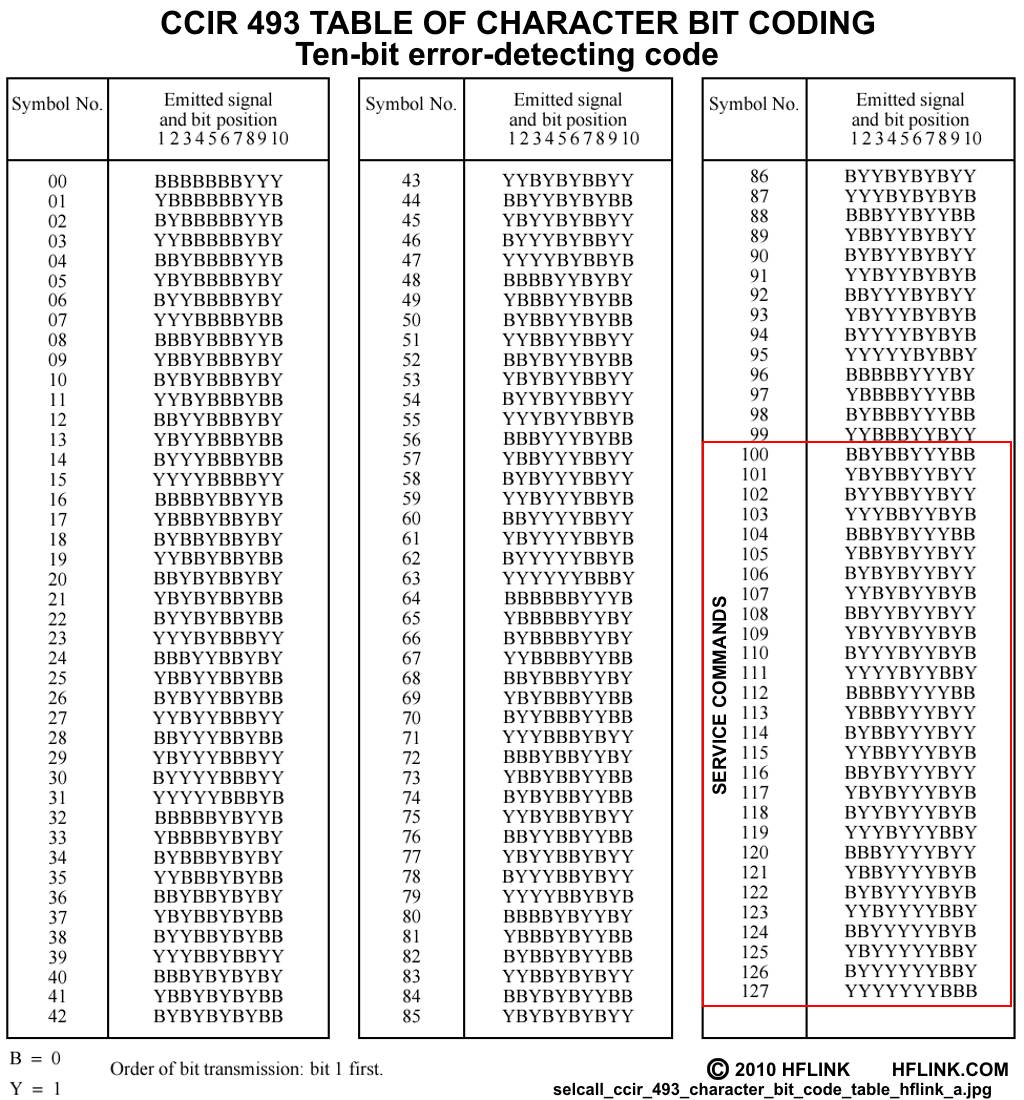
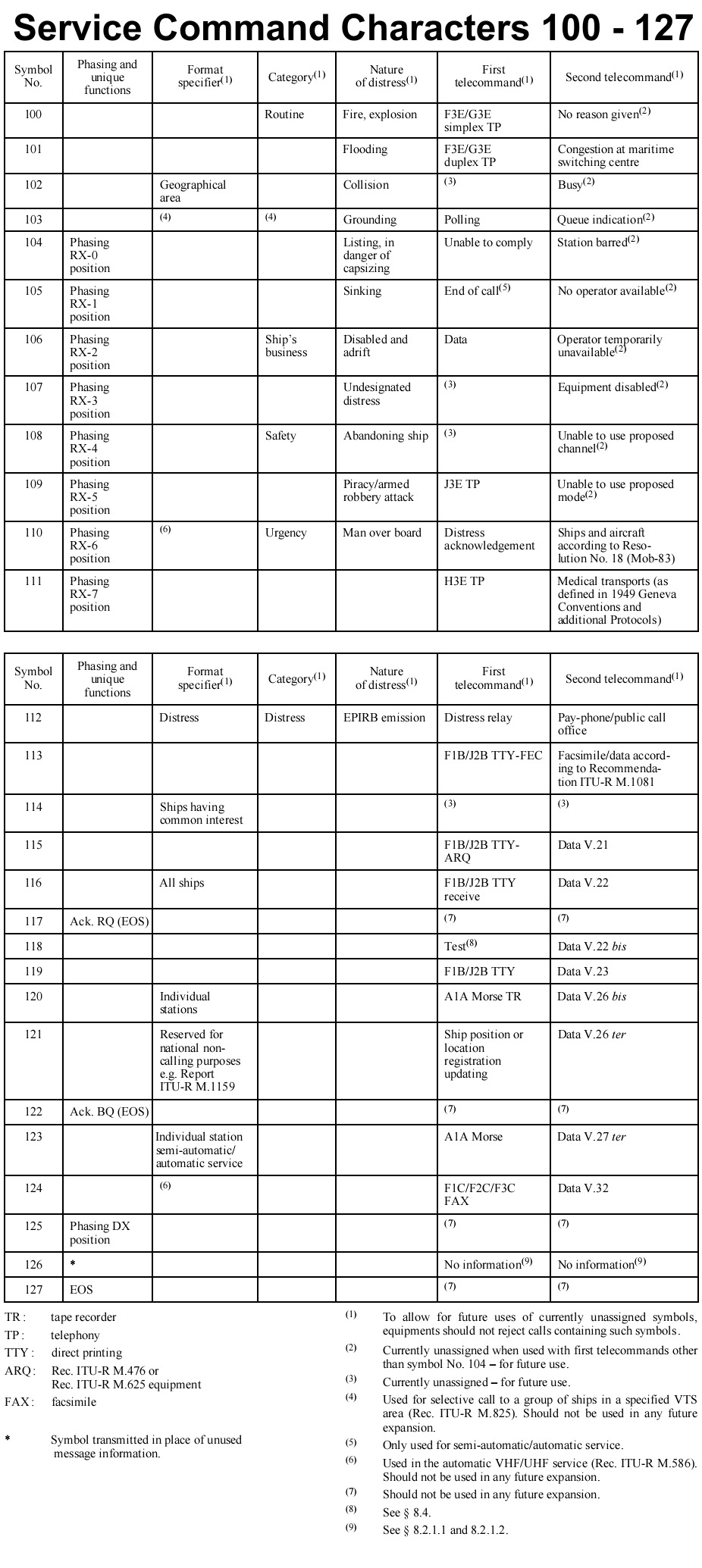
Protocol Details Character parity and error detection: The system is a synchronous system using characters composed from a ten-bit error-detecting code as listed in the CCIR 493 Table of Character Bit Coding.The first seven bits of the ten-bit code of the table are information bits. Bits 8, 9 and 10 indicate, in the form of a binary number, the number of B elements that occur in the seven information bits, a Y element being a binary number 1 and a B element a binary number 0. For example, a BYY sequence for bits 8, 9 and 10 indicates 3 (0×4+1×2+1×1) B elements in the associated seven information bit sequence; and a YYB sequence indicates 6 (1×4+1×2+0×1) B elements in the associated seven information bit sequence. The order of transmission for the information bits is least significant bit first but for the check bits it is most significant bit first. Time diversity: Time diversity is provided in the call sequence as follows: Apart from the phasing characters, each character is transmitted twice in a time-spread mode; the first transmission (DX or direct ) of a specific character is followed by the transmission of four other characters before the re-transmission (RX or repeat ) of that specific character takes place, allowing for a time-diversity reception interval of 400 ms. The classes of emission, frequency shifts and modulation rates are as follows: Character Symbol codes: The information in the call is presented as a sequence of seven-bit combinations constituting a primary code. The seven information bits of the primary code express a character symbol number from 00 to 127, as shown in the CCIR 493 Table of Character Bit Coding. The character symbols from 00 to 99 are used to code two decimal figures (i.e., a 2-digit number). The character symbol that represents a particular two-decimal figure is transmitted as the character symbol number that is identical to that particular two-decimal figure. For example, the character symbol 25 is equivalent to the number 25. Thus, any two-digit number may be sent. For numbers higher than 2 digits, a sequence of multiple number characters is used in a formatted message that includes service commands. The character symbols from 100 to 127 are not used for numbers, but instead are used as special service commands. The character symbol 126 is a special case NULL character symbol containing no information, and is used to "pad out" message content where needed for some purposes. Types of HF Land Mobile Selcalls and Remote Control Signals (source: Codan)
|
 |
| Reference
documents: Typical basic selcall radio flowchart (Codan sketch pdf) HF Selcall Evolution (Codan promotional ppt) U.N. Open Selcall 6 Digit (source: United Nations, pdf) GMDSS DSC ITU-R M.493-11 specification document (pdf) GMDSS DSC ITU-R M.493-9 specification document (pdf) CCIR HF Selcall 4-digit and 6-digit Interoperability (Barrett pdf) |
Sample Selcalls
Sample selcall recordings of different types of calls and radios are requested. Please contact HFLINK group forum if you can contribute on-the-air recordings. 4 Digit Selcall Sample Recordings Vertex VX1210: Selcall_3000_ALLCALL_from_3332_VX1210.mp3 Selcall_3332_calling_3332_VX1210.mp3 |
|||||||||||
Selcall demo video by John GM4SLV |
||||||||||||

Selective
Calling is in Compliance with FCC Rules
It is legal for USA hams to use Selective Calling and Alerting features in the phone subbands.
Selcall use in the USA Phone Bands
Currently, USA Amateur Radio Service operators have been utilizing Selective Calling (Selcall) in the USA Amateur Radio HF phone bands for at least 20 years without problems. Selcall transmissions in the phone bands comply with FCC rule: "Incidental tones for the purpose of selective calling or alerting or to control the level of a demodulated signal may also be considered phone."
FCC Rules for Selective Calling in the Phone Bands
Here are some excerpts of present Amateur Radio Service FCC rules permitting to the use of SELCALL for Selective Calling and Alerting in the PHONE sub-bands. Please note the last sentence in §97.3(c)(5) which is the definition of Phone mode. §2.201 of FCC Rules define emission type designators.
FCC §97.3 Definitions.
(c) The following terms are used in this Part to indicate emission types.
Refer to §2.201 of the FCC Rules, Emission, modulation and transmission characteristics, for information on emission type designators.
FCC §2.201
5) Phone. Speech and other sound emissions having designators with A, C, D, F, G, H, J or R as the first symbol; 1, 2 or 3 as the second symbol; E as the third symbol. Also speech emissions having B as the first symbol; 7, 8 or 9 as the second symbol; E as the third symbol. MCW for the purpose of performing the station identification procedure, or for providing telegraphy practice interspersed with speech. Incidental tones for the purpose of selective calling or alerting or to control the level of a demodulated signal may also be considered phone."
It is legal for USA hams to use Selective Calling and Alerting features in the phone subbands.
- Does Selcall signal comply with the FCC 300 baud rule?
- Yes. The CCIR493-4 signal is transmitted at 100 symbols per second (100 baud).
- Does the Selcall signal bandwidth comply FCC rules?
- Yes. The FCC does not currently specify an occupied bandwidth limitation, other than the stipulation that bandwidths must not be excessive.
- In the 60 meter Amateur Radio Service band at 5 MHz, the CCIR493-4 meets the bandwidth requirements.
Selcall use in the USA Phone Bands
Currently, USA Amateur Radio Service operators have been utilizing Selective Calling (Selcall) in the USA Amateur Radio HF phone bands for at least 20 years without problems. Selcall transmissions in the phone bands comply with FCC rule: "Incidental tones for the purpose of selective calling or alerting or to control the level of a demodulated signal may also be considered phone."
FCC Rules for Selective Calling in the Phone Bands
Here are some excerpts of present Amateur Radio Service FCC rules permitting to the use of SELCALL for Selective Calling and Alerting in the PHONE sub-bands. Please note the last sentence in §97.3(c)(5) which is the definition of Phone mode. §2.201 of FCC Rules define emission type designators.
FCC §97.3 Definitions.
(c) The following terms are used in this Part to indicate emission types.
Refer to §2.201 of the FCC Rules, Emission, modulation and transmission characteristics, for information on emission type designators.
FCC §2.201
5) Phone. Speech and other sound emissions having designators with A, C, D, F, G, H, J or R as the first symbol; 1, 2 or 3 as the second symbol; E as the third symbol. Also speech emissions having B as the first symbol; 7, 8 or 9 as the second symbol; E as the third symbol. MCW for the purpose of performing the station identification procedure, or for providing telegraphy practice interspersed with speech. Incidental tones for the purpose of selective calling or alerting or to control the level of a demodulated signal may also be considered phone."
CCIR493-4 can be used to start a
QSO, or for texting and data in the data subbands.
This web page facilitates and
constitutes public documentation of type CCIR493-4 HF Selective
Calling.
It fulfills the objectives of FCC
rules § 97.309(a)(4) :
- (4) An amateur station transmitting a RTTY or data emission using a digital code specified in this paragraph may use any technique whose technical characteristics have been documented publicly, such as CLOVER, G-TOR, or PacTOR, for the purpose of facilitating communications.
- Documentation should be adequate to (a) recognize the technique or protocol when observed on the air, (b) determine call signs of stations in communication and read the content of the transmissions.
END OF PAGE
©2001-2019 HFLINK. All Rights Reserved.
HFLINK, HF-LINK, HF LINK, and the HFLINK Logo are trademarks of HFpack Inc. Any external hyperlinks must only be to the main page of the HFLINK.COM website http://hflink.com . Capture of the HFLINK website or any part of it within the frame of another website is not permitted. HFLINK group forum is a private group. Public archiving, forwarding, or open display on the internet of HFLINK group forum or messages is forbidden. All text and images on the HFLINK website are property or copyright HFpack Inc, or when used by permission, are copyright by their respective owners, with all rights reserved.
HFN and High Frequency Network are service marks and trademarks of HFpack, Inc. No part of the HFLINK website or HFLINK Group Forum may be used or copied without written permission of HFpack Inc.